
Don't Just Ask About AI Tech. Start Asking Who's Training It.
TL;DR
Contact center AI is only as good as the people training it. High agent attrition means new hires, still learning the job themselves, are the ones validating and correcting AI responses, which produces shallow, inconsistent models.
Stable, experienced agents catch nuance, emotion, and context that newer agents miss, and that nuance is what turns a model from passable to genuinely useful.
When you evaluate outsourcing partners with AI capability in mind, ask about retention, tenure, and employee satisfaction before you ask about the tech stack. The cheapest provider with the highest churn is rarely the one that will train your AI well.
Training AI in the contact center is not really about technology first. It’s about people, process, and discipline. The most sophisticated model in the world will still struggle if it’s trained on inconsistent, low-quality inputs from a high-attrition customer service team that’s constantly changing.
For customer service leaders evaluating contact center outsourcing, agent tenure and strong job satisfaction matter more than ever. High attrition in outsourced customer service operations creates a problem beyond the obvious cost of recruiting and training new staff. It also means the people validating AI responses and correcting them are often the newest and least experienced members of the team. If the model is learning from people who are still learning themselves, it’s unlikely to become a reliable source of customer support.
Your AI is Only as Good as Your Attrition Rate
In many contact centers, high turnover means that AI feedback is being shaped by agents who have not yet developed deep product fluency or strong judgment. That creates a serious risk in both in-house operations and BPO customer support environments.
New hires often need weeks or months to fully understand policies, systems, and customer expectations, and some centers estimate that reaching real competency can take six to twelve months or longer. If those same agents are helping train AI too early in their tenure, the model can absorb shallow patterns, incomplete answers, and inconsistent resolution paths. In other words, the AI becomes a reflection of instability rather than expertise.
That’s why employee satisfaction is no longer just a soft metric. Teams with lower attrition preserve institutional knowledge, create better customer experiences, and generate stronger training inputs for AI. For buyers looking at customer experience (CX) outsourcing, that should be part of the evaluation from the start.
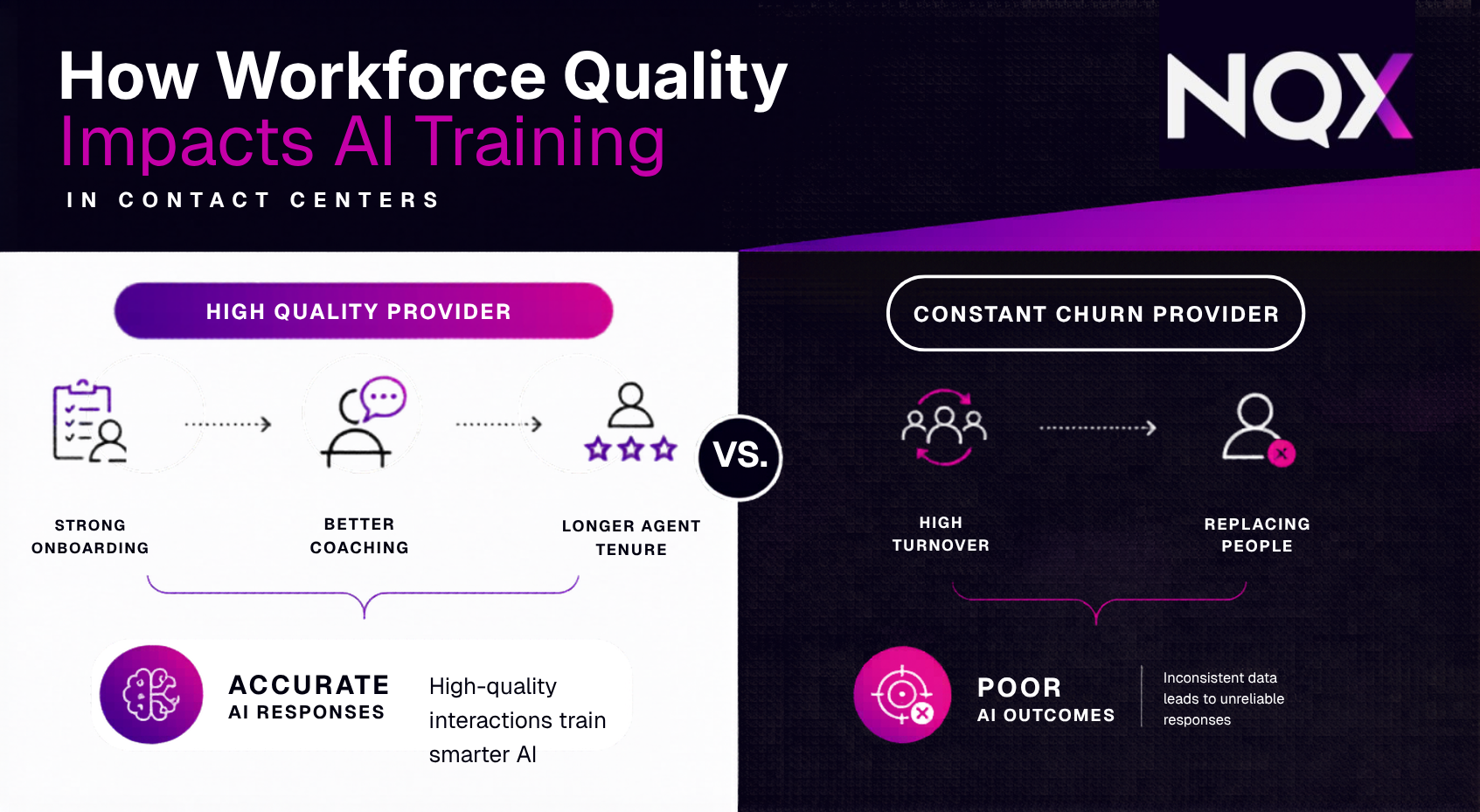
This is especially true in outsourced environments, where the quality of the provider’s workforce can directly affect the quality of the AI outcome. A provider with strong onboarding, better coaching, and longer agent tenure is in a much better position to accurately correct and augment AI responses. A provider with constant churn is likely to spend most of its energy replacing people instead of improving the system.
There is also a practical reality here. Experienced agents know the difference between what a customer asked and what the customer actually needed. They know how to spot context, emotion, urgency, and ambiguity. That kind of nuance is hard to teach a model unless it is coming from humans who already understand the job really well.
The issue is not just that new agents make mistakes. The issue is that the organization loses memory every time experienced agents leave. That is bad for service delivery, and it is bad for AI training too.
Choose a Knowledge-Stability Partner not Just a Provider
If AI is only as good as the human knowledge behind it, then employee satisfaction becomes a strategic metric. Contact centers with better employee satisfaction tend to have stronger retention, better coaching continuity, and more confident agents. Those are exactly the conditions AI needs to improve.
That is why outsourcing buyers should be asking different questions. Instead of relying too heavily on cost reduction and enabling technology as a decision factor, ask how providers retain their people. Ask about attrition rates, average agent tenure, internal promotion rates, and employee engagement scores. Ask what they do to keep agents motivated and how they reduce burnout.
The best outsourcing partners are not just labour providers. They are knowledge-stability providers. They create the environment where better data, better coaching, and better customer outcomes are possible. That is a major differentiator in AI and contact center technology programs that need to scale without losing quality.
AI in the Contact Center Is More than Technology
A mature AI training program in a contact center starts with stable operating conditions. That means a clear knowledge strategy, consistent documentation standards, and a workforce that is experienced enough to contribute useful examples. It also means the company has defined the use case carefully. Is the AI meant to assist agents, automate self-service, or support QA? Each of those requires a different training approach.
The best contact centers also connect AI training to business outcomes. They do not just measure whether the model was technically accurate. They measure whether it improved first-contact resolution, lowered average handle time, reduced escalations, and raised CSAT. If those metrics are not moving, the AI is not really helping.
For organizations considering outsourced customer service, this is where the provider’s maturity shows up. The best partners do not treat AI as a standalone technology layer. They integrate it throughout workflows so that every interaction improves the system over time.
Ask About Attrition, Not Just Tech Stack
For companies exploring contact center outsourcing, the opportunity is not just to reduce cost. It is to partner with a company that can train AI better than an in-house contact center with constant churn. That means asking the right questions, including:
What is your annual attrition rate?
What is your average agent tenure?
How do you measure employee satisfaction?
How do you preserve tribal knowledge when agents leave?
Who reviews and approves AI training data?
How often is the knowledge base updated?
How do you prevent new hires from influencing the model too early?
What metrics prove the AI is improving service, not just reducing headcount?
If a potential provider cannot answer these questions clearly, their AI capability may lack substance. That is especially important when evaluating call center partners for long-term customer support.
The real lesson
AI training in the contact center is only as strong as the people behind it. If the people portion of the CX organization is unstable, the AI model will inherit that instability. If the workforce is engaged, experienced, and well supported, the AI has a much better chance of becoming genuinely useful.
That is why employee satisfaction has never been more important. In the age of AI, it is no longer just an HR issue. It is a service quality issue, a data quality issue, and a competitive advantage. For customer service leaders evaluating contact center outsourcing partners, the best choice is not just the lowest-cost option. It is the one with the strongest people, the lowest attrition, and the most dependable knowledge base to train from.
Frequently Asked Questions
How does agent attrition directly affect AI model quality in a contact center?
When agents leave frequently, the people left to validate and correct AI responses tend to be newer and less experienced. Because reaching full competency can take months, models trained or refined by those agents risk absorbing incomplete answers, shallow reasoning patterns, and inconsistent resolution paths. Over time, the AI ends up reflecting workforce instability rather than genuine expertise.
What should I prioritize when evaluating a contact center outsourcing provider's AI capabilities?
Look beyond the technology pitch and dig into workforce metrics. Ask specifically about annual attrition rates, average agent tenure, internal promotion rates, and how the provider preserves institutional knowledge when experienced agents leave. A provider that cannot answer those questions with specifics is likely to have an AI program built on an unstable foundation, regardless of how advanced the underlying tools appear.
How do you measure whether AI is actually improving contact center performance?
Technical accuracy alone is not a sufficient measure. The metrics that matter are operational: first-contact resolution rates, average handle time, escalation frequency, and customer satisfaction scores (CSAT). If those numbers are not improving alongside AI deployment, the model is not delivering real service value. Instead, it may simply be automating existing problems rather than solving them.

About the Author
As President & Chief Executive Officer of NQX, he is a people-focused leader with over 30 years of experience in the telecommunications industry. He has led the company’s growth from 1,300 to 10,000 employees, expanded its services into digital and IT solutions, and strengthened its presence across Canada and the Philippines. His leadership ensures NQX’s long-term strategy, performance, and customer experience priorities are effectively executed and aligned with business goals.